Article
AI agent regulation in Israel: spam, privacy and disclosure
AI agent regulation in Israel rests on existing law: the spam law (opt-in, up to ₪1,000 per message), Privacy Law Amendment 13, and where AI disclosure stands.
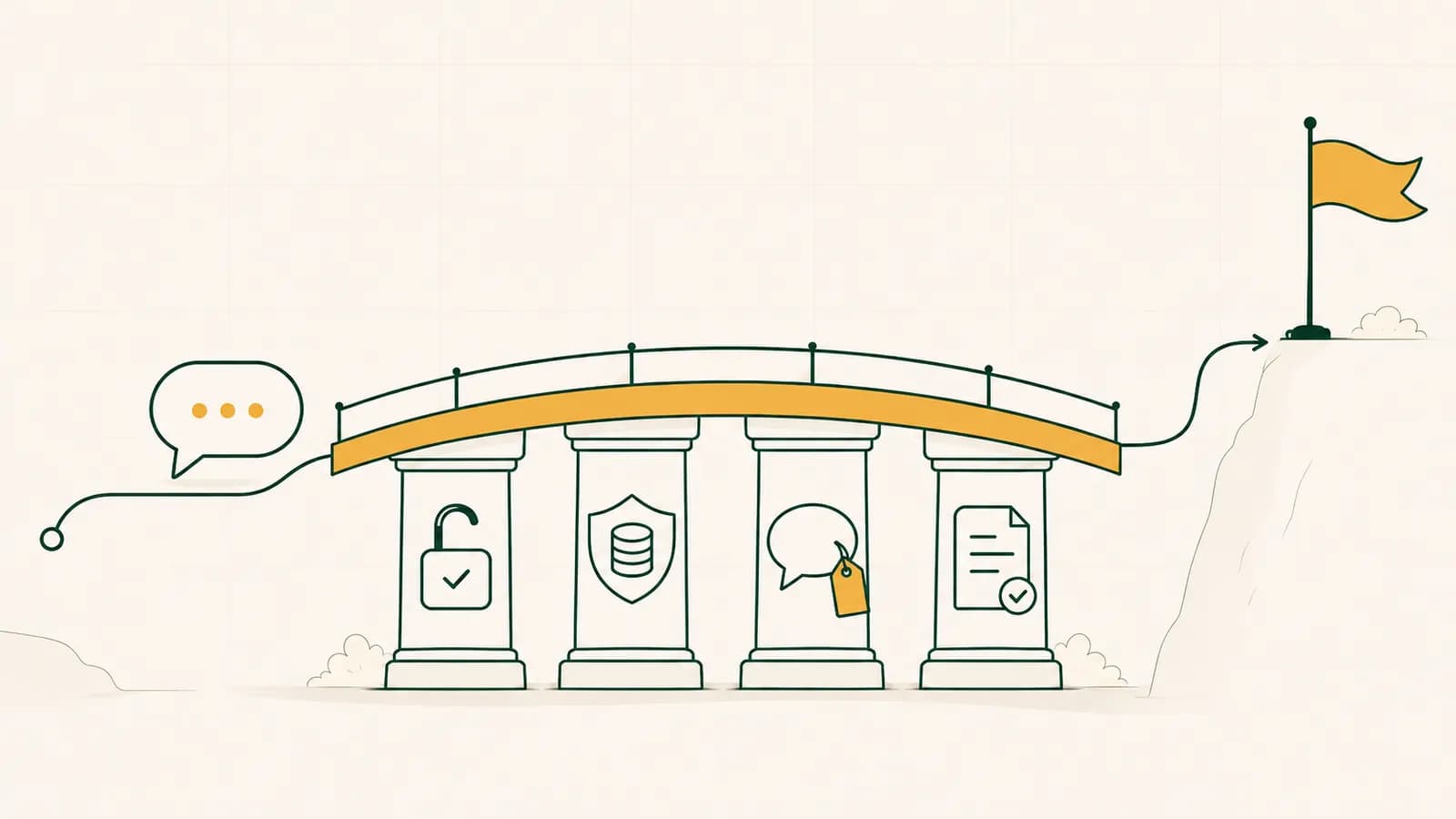
AI agent regulation in Israel rests on existing law, not a dedicated AI act: the spam law (prior consent, damages up to ₪1,000 per message), Amendment 13 to the Privacy Protection Law, and consumer protection (closing in chat). No binding AI law yet, but the direction is transparency: telling customers they are talking to an automated system.
As more businesses run AI agents that handle sales conversations, answering, reaching out, closing, a question comes up that few stop to ask: what is allowed, and what exposes us? Regulation in this area is not "coming". It is already here. This article sorts it out: what the law requires of an AI agent that sells in Israel, what is about to change, and how to do it properly. Israel's spam law on WhatsApp has its own separate article.
An important note before anything else: this is an educational explainer, not legal advice. The law is complex and keeps changing, and every business should consult a lawyer about its specific situation. The situation described here is as of October 4, 2026.
The spam law, the most important rule for proactive outreach
If your agent reaches out to customers, rather than only answering people who wrote to you, this is the law to know first.
The spam law is section 30A of the Communications Law (Bezeq and Broadcasts), Israel's anti-spam provision, added in Amendment 40 (Israeli Book of Laws 2153, June 1, 2008, in Hebrew) and in force since December 1, 2008. It applies to "advertising material", a message distributed commercially to encourage a purchase, sent by fax, automatic dialer, "electronic message" or SMS. Its central rule is simple and rigid: no sending advertising material without the recipient's explicit prior consent (opt-in). The consent has to be in writing, and the law explicitly recognizes consent given by electronic message or in a recorded call.
Here is the point many businesses miss: accepting a website's "terms of use", with a consent clause buried inside, is not explicit consent under the law. So the Tel Aviv Magistrate's Court held in a class-action certification decision (CA 66117-12-23, October 1, 2024, in Hebrew). Consent has to be clear and specifically for receiving marketing messages, not something the customer "approved" in passing by clicking a form.
There is a narrow exception for existing customers (section 30A(c)): you may reach out without prior opt-in only if all three conditions hold: the customer gave their details during a purchase or negotiation and was told they would be used for advertising; was given a chance to refuse and did not; and the advertising concerns a product or service of a similar kind. And even then, every message must carry an opt-out.
Enforcement is real. Anyone who sends advertising material knowingly in breach of the law is exposed to exemplary damages of up to ₪1,000 for every message, with no need for the recipient to prove damage. It can also ground a class action, as in the 2024 case above. Precision matters here: in LCA 2904/14 Glasberg (July 27, 2014), Justice Rubinstein of the Supreme Court, sitting alone, called the ₪1,000 ceiling a starting point from which courts may reduce in suitable cases, not an award of the maximum every time the law is breached (the ruling, in Hebrew). But the cumulative exposure, especially in a class action, is significant.
And WhatsApp? This calls for care. Content decides: a sales message is "advertising material" in any app. The question is the channel. The law covers an "electronic message", and the courts apply it to WhatsApp: in February 2026, for example, the Jerusalem Small Claims Court awarded damages for every message in a series that included WhatsApp messages (SC 18944-08-25, February 5, 2026, in Hebrew). These are lower-court rulings, and no Supreme Court ruling to the contrary has been found. The right caution: treat it as subject to the law, and do not rely on a gray area.
What this means for an AI agent that reaches out to leads
In practical terms: if your agent sends proactive messages that promote a product or service, every such message is "advertising material", and therefore:
- Opt-in is needed before the first outreach. A lead who left details in a campaign has not necessarily consented to marketing messages; you need clear, specific consent.
- Every advertising message must identify itself: the word "advertisement", the sender's name and contact details, and the right to opt out with a simple way to do it.
- Accepting "terms of use" is not enough. If the consent rests on a click on a general form, it probably does not meet the explicit-consent requirement.
- Opt-out has to work, at any time, at no charge beyond the cost of sending it, in writing or on the same channel the message came through, as the customer chooses.
Note that this applies to proactive outreach. Replying to a customer who wrote to you first is a different story; there, they opened the conversation. That distinction, between initiating and responding, is the practical boundary of the spam law.
Privacy: Amendment 13 to the Privacy Protection Law
An AI agent that stores conversations, leads and customer details is running, in the law's terms, a database, and that triggers the Privacy Protection Law. And in August 2025 that law went through what the Privacy Protection Authority calls its most comprehensive update since it was enacted in 1981.
Amendment 13 to the Privacy Protection Law (5784-2024) passed the Knesset on 5 August 2024, was published in the official gazette (Book of Laws 3287, in Hebrew) and took effect on 14 August 2025. According to the Privacy Protection Authority's guide (in Hebrew), it changes several things that matter to a business running a conversational agent:
- Database registration in the private sector, almost entirely abolished, but the substantive duties remain. Even without a registration duty, everything else still applies.
- A notice when collecting data. When the agent collects details from a customer, it has to tell them, under section 11, for what purpose, whether there is a legal duty to provide the data or it is given voluntarily, what happens if they refuse, to whom the data will be passed, and what their rights are to access and correct it.
- Data security. The Privacy Protection (Data Security) Regulations of 2017 still apply: a security procedure, access controls, logging, and handling security incidents.
- A Data Protection Officer (DPO). Required, among other cases, where the core activity is ongoing, systematic monitoring at significant scale, or the processing of data of special sensitivity at significant scale.
Enforcement has grown much stronger. According to the Authority's guide, the amendment lets it impose financial sanctions that can reach millions of shekels per breach. Alongside that, the law lets a court award exemplary damages of up to ₪10,000 without proof of damage, for a defined list of breaches (section 15A). In short: a database of sales conversations is not "just data", it is a legal asset that has to be managed responsibly.
The duty to disclose that it is AI: where things stand
This is the question most people ask: do you have to tell the customer they are talking to an AI? The answer, as of October 2026, is precise and interesting.
Israel has no binding law yet that explicitly requires disclosing that an interaction is run by an AI system. Israel chose "soft regulation": the policy document on principles for regulation and ethics in artificial intelligence (in Hebrew) of the Ministries of Innovation and Justice, from December 2023, says regulation will be "sectoral, not cross-cutting", that is, through each sector's regulator, without one AI law that applies to everyone.
The closest thing to a duty to disclose is a draft guideline of the Privacy Protection Authority (April 2025, in Hebrew). Under it, when the party talking to a person is not a human but an automated, AI-based system, the person should be told so, to the extent that this fact may materially affect the consent they give. But, and this matters, it is a draft. As of October 2026 no final version has been published, and it must not be treated as an existing duty; it is an indication of direction, not law.
Elsewhere, by contrast, the direction is already binding. The EU AI Act (Regulation (EU) 2024/1689) provides in Article 50(1) that systems intended to interact directly with people must ensure the person knows they are interacting with an AI system, unless that is obvious. This transparency duty applies from 2 August 2026, and the amendment that entered into force in July 2026 did not change it. Breaching it exposes a company to fines of up to €15 million or 3% of global turnover, whichever is higher (for small and medium-sized businesses, whichever is lower). An Israeli business serving customers in the EU is subject to it. In the US the picture varies by state. California's BOT Act, in force since July 2019, prohibits using a bot to mislead a person about its artificial identity in order to drive a purchase, and a clear disclosure that it is a bot takes you outside the ban. In Utah, since May 2025, a business must disclose that the customer is talking to generative AI when the customer clearly asks, and regulated occupations must disclose it up front in high-risk interactions.
And here is our angle. Upperfloor is a managed AI sales system on WhatsApp for businesses that already receive inquiries. We do not claim that AI cannot be detected, and we do not sell an "undetectable bot". We build an agent that runs a natural, human conversation, and always leaves a path to a person. That position is not only right in principle; it also anticipates the law. While regulation worldwide is moving clearly toward a duty of transparency, whoever built on honesty from the start is already on the right side.
Closing and payment in chat: consumer protection
One more layer, for anyone whose agent closes and collects payment in the conversation. Such a transaction is a "distance sale" under the Consumer Protection Law (section 14C, in Hebrew), and brings duties of its own:
- Identifying the business: name, ID or company number, and address, alongside the product details, the total price and the cancellation terms.
- The right to cancel: in a distance sale the consumer may cancel within 14 days, on the terms set in the law. For people with disabilities, senior citizens and new immigrants the period is longer, up to four months, provided, in the statute's words, that the transaction "included a conversation between the business and the consumer, including a conversation by means of electronic communication" (section 14C1(c)).
In other words, when the agent closes a deal, it is not only "making a sale", it is entering the space of consumer disclosure duties. A properly built system includes those disclosures in the closing flow.
How to do it properly
Boiling all the regulation down to practice, it looks like this:
- Real opt-in before proactive outreach, clear and specific consent, not "terms of use".
- Identification and opt-out in every advertising message, "advertisement", the sender's name, and a simple way to opt out.
- A notice when collecting data, and compliance with the Data Security Regulations.
- A path to a person and fair disclosure, not "disguise", in line with the regulatory direction in Israel and abroad.
- Consumer disclosure at the close, the business's identity and the right to cancel.
The list looks long, but note: almost every item on it is what a managed sales system does anyway when it is built properly, consent, clear identity, a path to a person, and orderly documentation. Regulation does not clash with good management; to a large extent, it is the definition of it. The legal responsibility always stays with the business, but a system built with these rules from the start turns "doing it properly" from a burden into a built-in feature.
FAQ
Can you send sales messages on WhatsApp without the customer's approval? No. Israel's spam law (section 30A of the Communications Law) requires explicit prior consent (opt-in) before sending advertising material. Sending without consent exposes you to damages of up to ₪1,000 per message, with no proof of damage. Accepting a website's "terms of use" does not count as explicit consent, as the Tel Aviv Magistrate's Court held in October 2024.
Do you have to tell the customer they are talking to an AI? Israel has no binding law yet that requires it explicitly, only a draft guideline of the Privacy Protection Authority (April 2025) that leans that way and, as of October 2026, is still a draft. Under the EU AI Act, by contrast, from 2 August 2026 a system that interacts directly with people must let them know it is an AI system, unless that is obvious. The global direction is clear: transparency.
What is the penalty for sending spam in Israel? The spam law lets the court award exemplary damages of up to ₪1,000 for every advertising message sent knowingly in breach of the law, with no need to prove damage. It can also ground a class action. The Supreme Court has called the ₪1,000 a starting point that courts may reduce in suitable cases (LCA 2904/14 Glasberg, 2014), not an automatic award.
An AI agent that stores customer conversations: what are the privacy duties? A database of conversations and leads is subject to the Privacy Protection Law. Since Amendment 13 (in force from 14 August 2025) you must give the customer a notice when collecting the data, comply with the Data Security Regulations, and in some cases, such as processing sensitive data at significant scale, appoint a Data Protection Officer. Breaches expose you to financial sanctions and, for a defined list of breaches, to statutory damages.