Article
AI sales agents: working with reps, and when humans step in
An AI sales agent takes the coordinator's job, not the close: what it holds, when the closer steps in, and which deals it closes on its own.
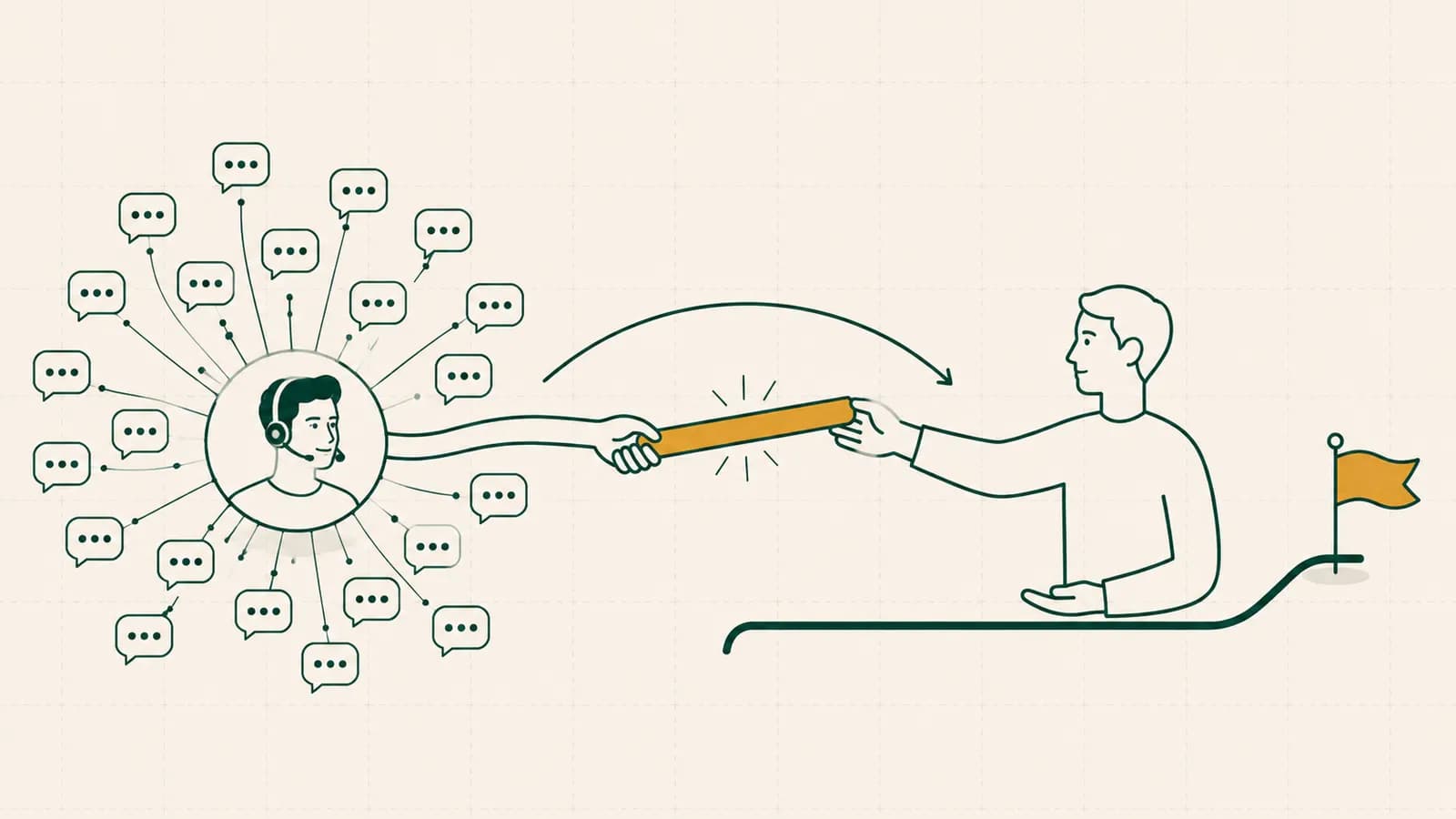
An AI sales agent takes the coordinator's job, not the close: instant replies, qualification, follow-up, screening, documentation. The closer steps in for trust, negotiation or judgment. In a managed AI sales system about 10-20% of deals, off-the-shelf products needing no trust, close autonomously end to end; about 80-90% reach the closer ready to close, with context.
The rep took a day off. Two follow-ups didn't go out, and nobody noticed. Nobody was fired and nobody was replaced, and still two leads walked. The agent does not replace the salesperson. It reveals who was a salesperson and who was a coordinator with a sales title. That is this article's claim, and it has two axes: the product decides whether a closer is needed, and the person decides whether they are one. What an AI agent even is, in a separate article. Here: who does what, and why.
The fear: "AI will replace my team"
The usual picture is a race: AI versus a person, one wins, the other is let go. The fear is legitimate, and it is aimed at the wrong job. The job that is ending is not the salesperson. It is the coordinator: the person who answers, qualifies, follows up, books meetings, and does not close. In many businesses that job is called "sales", and for years it was necessary, because someone had to hold the continuity. Now the agent holds it. Whoever's whole job was the continuity is left without a job, and whoever closes gets more of the conversations that need them. It is not "AI or a person". It is "AI or a coordinator", and a closer either way.
What a sales rep actually does all day
In Salesforce's seventh State of Sales report, a survey of 4,050 sales professionals published in 2026, reps report spending 60% of their time on non-selling tasks, including data entry and lead research (Salesforce, State of Sales 2026).
That 60% is not "wasted time". It is a whole job, the coordinator's job, which most teams never defined as a separate role and so spread across everyone. The most expensive person on the team spends most of the week on things they were not hired for, and that is exactly where things slip: the lead that wasn't entered, the follow-up written on a sticky note, the conversation that wasn't documented. And when someone on the team does only that, all week, they have a sales title and a coordinator's job. When an agent takes the 60%, whoever closes has more time to close, and whoever only coordinated has nothing left. It is not pleasant to read, and it is what the number says.
The division of labor, who does what
| The AI agent holds | The closer holds | |
|---|---|---|
| Nature of the task | Repetitive, structured, rests on data | Unique, sensitive, needs judgment |
| Examples | 24/7 availability, immediate reply, follow-up, lead screening, documentation, scheduling | Building trust, negotiation, handling a sensitive customer, a complex close |
| The value | Consistency, nothing forgotten and nothing asleep | Judgment, the things that cannot be scripted |
The table looks like a split by ability. It is a split along two axes. The first axis is the product: an off-the-shelf product bought from immediate need, without emotion or a relationship, never needed a salesperson. Whoever sold it was an order-taker with a sales title, and the agent takes that role entirely. A purchase that needs trust, emotion or a relationship needs a real closer, and the agent's job is to bring the customer to that closer ready. The second axis is the person: the agent takes what fails on continuity, forgetting, fatigue, a day off, and leaves the person what needs judgment, when "fine" means "no", and when to walk away from a deal. Whoever's job is that judgment is a closer. Whoever's wasn't, was a coordinator.
And from the closers' side it sounds like this: in Salesforce's 2026 report, 88% of reps working with AI agents say it raises their odds of hitting their targets (Salesforce, 2026). Reps do not like tools that add work, which is what makes that number interesting: whoever closes gets from the agent exactly what they wanted, more of the conversations that need them and less of the coordination around them.
Why follow-up fails with people, and not with an agent
A rep's attention is a queue, and the queue is sorted by who wrote last and who shouts loudest. A lead who went quiet for two days did not become less important; it simply dropped off the screen, because twenty new conversations piled up on top of it. The note "call back Wednesday" is a schedule that depends on the person being there on Wednesday, remembering, and having a free moment. Three conditions, and each of them fails sometimes.
An agent's queue is sorted by time, not by noise. "Quiet for two days" is, for it, a signal to act, not a gap. It does not remember better than a person; it simply does not need to remember, because the schedule drives it. And that is the real explanation for the split: not that the AI is smarter, but that it is the only one whose continuity does not depend on attention.
Exactly when the person steps in
The guiding line: autonomous as far as possible, up to the point where a person is needed. And the axis that decides where that point is, is not price. About 10-20% of deals close autonomously end to end: off-the-shelf products, when the product is clear, the price transparent and the need already formed. At IMBODY the agent closes an expensive fitness machine in chat, because all three conditions hold. About 80-90% reach the closer, but not from zero: after the agent replied at once, qualified, handled the first objections, followed up, and brought the customer to the point where what the conversation alone cannot build is needed. Trust. Judgment. A complex close. The axis is whether the purchase needs trust the conversation alone cannot build.
Back to the rep's day off, and what it looks like in four messages:
- The customer, Monday: "Send me a quote, I'll think about it." The rep sends it, and notes to call back Wednesday. On Wednesday he is off.
- Without an agent: Wednesday, Thursday, Friday, silence. By Sunday the quote is old, and the customer is mid-conversation with someone else.
- With an agent, Wednesday morning: "Did you see the quote? Anything unclear in it?" The customer: "The price is higher than I thought." The agent: "Higher than you thought, or higher than what you got elsewhere?"
- The customer: "I got a cheaper quote, but without installation." The agent explains what the price includes, and offers a ten-minute call with the closer on Sunday. On Sunday the closer joins a warm conversation, knowing what the competing quote is and what it lacks.
The closer did not open a cold conversation. And a clear path to a person is what customers ask for: in a Gartner survey from July 2024, customers' first concern about AI in customer service was the difficulty of reaching a person (Gartner, 2024). That changes how the handover is built. Not a hidden button after five questions, but an exit you can see: a customer who asks for a person gets a person, and a customer whose conversation has reached a point that needs judgment is passed on without asking. The handover is the design, not the failure.
What changed in 2026: the agents are already at work in organizations
In Deloitte's State of AI in the Enterprise report, organizations are already deploying AI agents, and the highest impact is expected in customer support of all places (Deloitte, 2026). It is no accident that agents land in that function first. Support is where the work repeats but happens in conversation, exactly the combination an agent is built for, and sales is the next door over: the same conversation, with a goal. What remains to decide is not whether, but where the line runs.
What it gives the team, and the business
Part of your sales team does not sell. It coordinates. That is the hardest claim to hear, so here is the defense: back to the 60%. If someone on the team spends the whole week answering, qualifying, following up and booking meetings, and does not close, the agent does their job, all of it, and there is nothing left for them to do. And whoever closes gets what they never had enough of: ripe conversations, with context, without chasing leads and filling in forms. Not fewer salespeople. Less coordination, and more closing per closer. And that is what the agent makes visible: it does not replace the salesperson. It reveals who was a salesperson and who was a coordinator.
Upperfloor is a managed AI sales system on WhatsApp for businesses that already receive inquiries. At a staffing agency we work with, the agent runs up to 100 conversations a day of screening and matching, and the recruiter steps in for the placement itself. At a premium travel company the agent runs the qualification and follow-up, and a person closes the details. And in our campaign in August-September 2026 the agent handled 95 leads and brought 9 of them to a paid meeting, without a rep touching the conversation before the meeting. The same pattern every time: the agent holds the coordination, the closer does what only they can. Proven with over 100 business owners in Israel.
How to combine them properly
Start with two honest questions. On the product: does the purchase need trust the conversation alone cannot build? If not, the agent closes. If so, the agent brings the customer to the closer. And on the team: who here closes, and who coordinates? The more of the coordination moves to the agent, the more strength the closer has left for the part only a person does. And the handover at the line has to be smooth, a ready-to-close lead with full context, not a blank page.
Look at the last ten deals that closed. In how many did someone have to build trust, and in how many did someone just have to answer in time? The first answer tells you what product you sell. The second tells you who on the team closes.
FAQ
Will an AI agent replace sales reps? An AI agent does not replace the salesperson; it takes the coordinator's job (reply, qualification, follow-up, documentation) and reveals who on the team really closes. In a managed system about 80-90% of deals reach the closer ready to close, and about 10-20%, off-the-shelf products that need no trust, close end to end.
What does an AI agent do well in sales, and what is better left to a person? An AI agent excels at tasks that repeat and rest on data: an immediate reply at any hour, scheduled follow-up, lead screening and documentation. A person is essential where trust, empathy, judgment and complex negotiation are needed.
When does a person step into a sale run by an AI agent? A person steps in when judgment, a complex close, negotiation, a sensitive customer or an unusual decision is needed. The agent manages the path up to that point and passes the closer a ready-to-close lead with full context; about 10-20% of deals, off-the-shelf products, close autonomously.
How does an AI sales agent help the team instead of replacing it? An AI agent gives reps back time: according to Salesforce (2026), reps spend 60% of their time on non-selling tasks. When the agent takes the repeating part, the closer works more on ripe conversations and less on admin.
What is the difference between an AI agent and a human sales rep? An AI agent is always available, consistent, and never forgets a follow-up; a human rep brings trust, judgment and negotiation. In a managed system the two split the work: the agent manages the continuity, the rep closes.
If you want to see where that line runs in your business.