Article
Lead leakage: where leads get lost and what it costs
Leads fall because of management, not for lack of inquiries: slow replies, forgotten follow-up, no single picture. Where leads leak and what it costs.
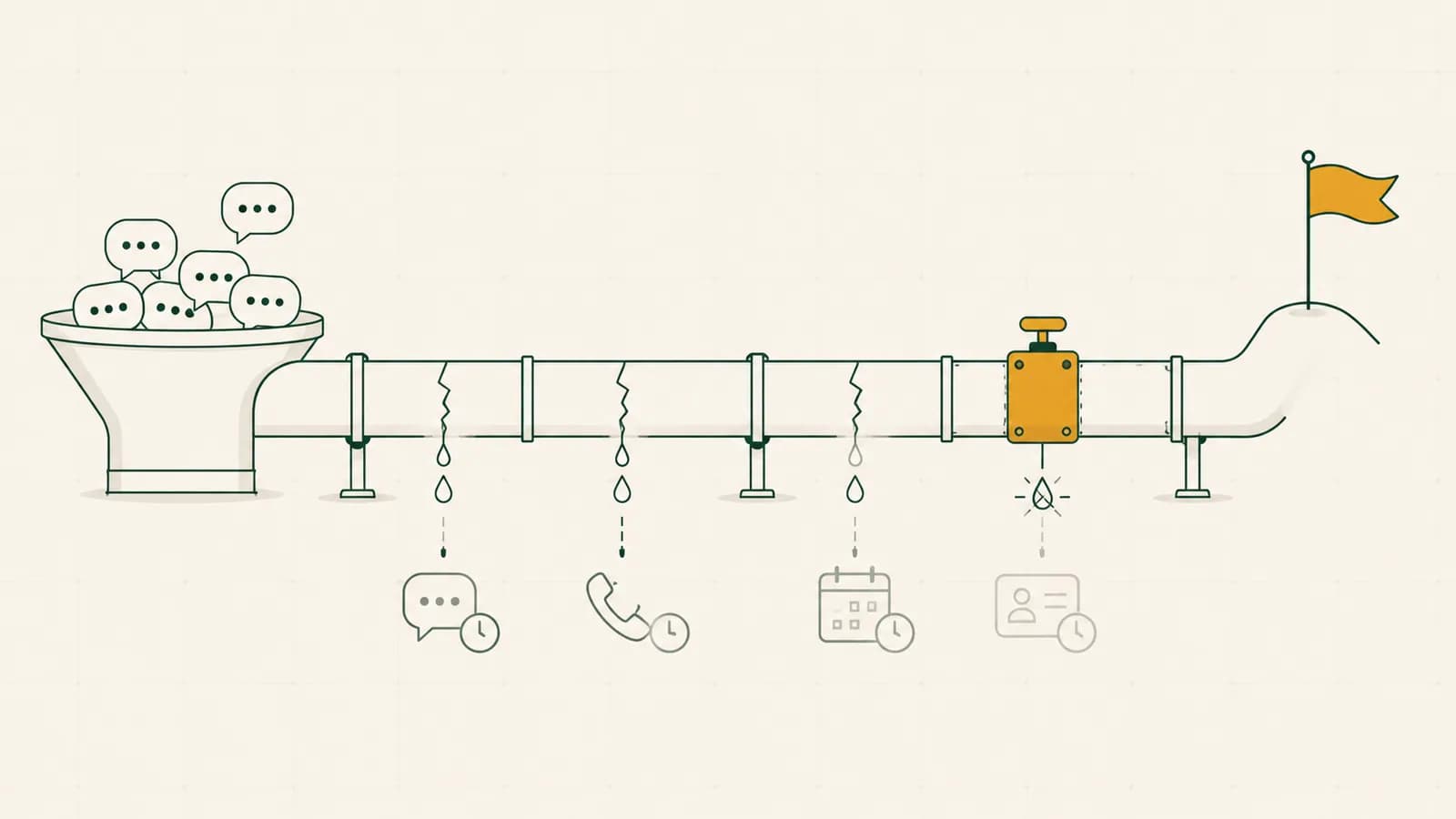
Lead management decides whether an inquiry becomes a deal. Leads fall not for lack of inquiries but from slow replies, forgotten follow-up, and no single picture of who is serious and where things are stuck. The fix is a system that manages the path: instant replies, follow-up that never slips, and a ready-to-close lead for the rep.
Upperfloor is a managed AI sales system on WhatsApp for businesses that already receive inquiries.
Almost every business owner knows the feeling: leads "evaporate". Inquiries come in, some look promising, and then, nothing. The first reflex is to blame lead quality, or to buy more. But that's usually the wrong diagnosis. The problem is almost never volume; it's management. In this article we'll show where exactly leads leak, three measurable places, what it really costs, and why the answer is not more leads.
The problem isn't volume. It's management
Start with the most expensive mistake. A business feels leads are falling, so it raises the marketing budget and brings in more. Here's what happens: the same leak rate, on a bigger base. More leads come in, the same share falls, now just in larger numbers. Spend went up; conversion didn't.
That happens because the leak isn't at the entrance. It's in the process. The problem isn't that there aren't enough inquiries; it's that no system manages what happens to them after they arrive. The exact same lead behaves completely differently at a business that manages the path and at one that doesn't, not because of the lead, because of the handling. And that's the good news: a leak caused by management can be sealed without spending another shekel on marketing.
Where exactly leads fall
The leak isn't mysterious. It happens in three places, and each one can be identified.
Leak 1: slow replies (or none)
This is the first leak, and the biggest. A lead comes in, and nobody answers in time. Sometimes nobody answers at all: per a study by LeadSigma (2021-2022, covering about 21,000 companies; a vendor figure, not audited), about 34% of businesses never follow up on inbound leads at all. Sometimes they answer, but late: a 2018 Drift review found only about 42% of B2B companies responded to an inquiry within five days, meaning 58% did not.
Why is this so critical? Because the window of opportunity is measured in minutes and hours, not days. The best-known study in the field, published in Harvard Business Review (2011), found that businesses contacting a lead within an hour were about 7 times more likely to have a meaningful conversation with the decision maker than those who waited even one hour more. A slow reply isn't "slightly worse". It's a collapse of the odds. (We go deeper on response times and the exact numbers in the article on lead response time.)
Leak 2: forgotten follow-up
The second leak starts after the first reply. The lead got an answer, said "let me think", asked for a quote, or simply went quiet, and here the sequence breaks. Follow-up depends on the memory of a busy rep, and human memory is exactly where leads disappear. Nobody decided to throw the lead away; simply nobody got back to them. In sales that take several touches to a decision, a lead that never got its second and third follow-up is a lost lead, not because it wasn't relevant, but because nobody held the sequence.
Leak 3: no single picture
The third leak is the quietest, which makes it the most dangerous. Ask a business owner "what's happening with this customer?" and you'll get a partial answer. The information is scattered: some in WhatsApp, some in the CRM, some in a rep's head. Who's serious, who's hesitating, who's waiting for a callback, and where each deal is stuck, none of it appears as one picture. And without a picture, you can't manage: hot leads go cold with nobody noticing, because nobody looked at the queue as a whole. The conversations already tell the story; nobody sees them together.
What it really costs
Now the math. And here something must be said about numbers: you'll often see a figure like "79% of leads never convert to a sale", attributed to Salesforce or MarketingSherpa. We won't use it. We couldn't locate a primary source, and it looks like marketing folklore that kept rolling. What is verified is bad enough without inventing.
The real cost of lead leakage is double. First, money already spent: every lead cost something to generate, advertising, campaigns, time. A leaked lead isn't "zero"; it's an expense you paid for and got nothing back. The more expensive your leads are to generate, the more expensive the leak. Second, deals that walked: they didn't vanish, they went to whoever replied faster, remembered to follow up, and managed the path. In sales, a lead that wasn't handled at your business usually closes at someone else's.
And this is the point that turns frustration into economic pain: you pay twice. Once to generate the lead that leaks, and again when the competitor closes it. Neither expense appears in any report, but they are the largest ones.
What businesses with managed sales do
The other side of the picture: what a business looks like after sealing all three leaks. Not by hiring more reps, but with a system that holds the sequence.
- An immediate reply to every inquiry, at any hour. The first leak closes. No lead waits for morning.
- Follow-up that is never forgotten. The agent remembers who's waiting for a callback and returns at the right moment, without leaning on human memory. The second leak closes.
- One picture of all deals. A dashboard that shows who's serious and where every deal stands. The third leak closes.
- The result: the lead reaches the rep already ready to close, with full context, instead of getting lost on the way.
That's exactly what a managed AI sales system does: it doesn't bring more leads. It makes sure the leads you already have don't fall through the cracks. Same inquiries, different management, different outcome.
How to diagnose the leak in your business
Before changing anything, three diagnostic questions you can ask today:
- When was the last after-hours inquiry answered? If the answer is "the next day", that's leak one.
- How many follow-ups did the last unresponsive lead get? If there's no precise answer, follow-up depends on memory, and that's leak two.
- Where do your ten most important open deals stand, right now, without asking anyone? If you have to ask, there's no single picture, and that's leak three.
The three answers draw your leak map. And the good news is that none of them is a willpower problem or a budget problem. They're all the result of having no system that manages the path. Not a CRM that waits for you to update it; a system that manages what happens next.
Frequently asked questions
Why do leads fail to close, or just "evaporate"? Usually not because of lead quality, but because of management. Leads fall in three places: slow replies (or no reply), forgotten follow-up, and no single picture showing who's serious and where every deal stands. The same leads, under managed handling, behave differently.
How many businesses never follow up on leads at all? Per a study by LeadSigma (2021-2022, about 21,000 companies; a vendor figure), about 34% of businesses never follow up on inbound leads at all. Another figure, from Drift (2018), found only about 42% of B2B companies responded to an inquiry within five days. That gap is a structural leak.
What does poor lead management cost? A double cost: money already paid to generate the leads, wasted, and deals that went to whoever replied faster. Per HBR (2011), replying within an hour multiplies the odds of a meaningful conversation by about 7. A leaked lead isn't just "a lead that didn't close"; it's an expense you already paid for.
How do you stop losing leads? Not by buying more leads, but with a system that manages the path: an immediate reply to every inquiry, follow-up that is never forgotten, and one picture of all open deals. That way the lead reaches the rep ready to close instead of getting lost.
If you feel leads at your business are evaporating and you're not sure where.