Article
Automated Recruiting System: Handle Volume Without Hiring
A recruiting system that manages both sides of the market: screening, matching to open roles, scheduling interviews at scale. The team works on placements.
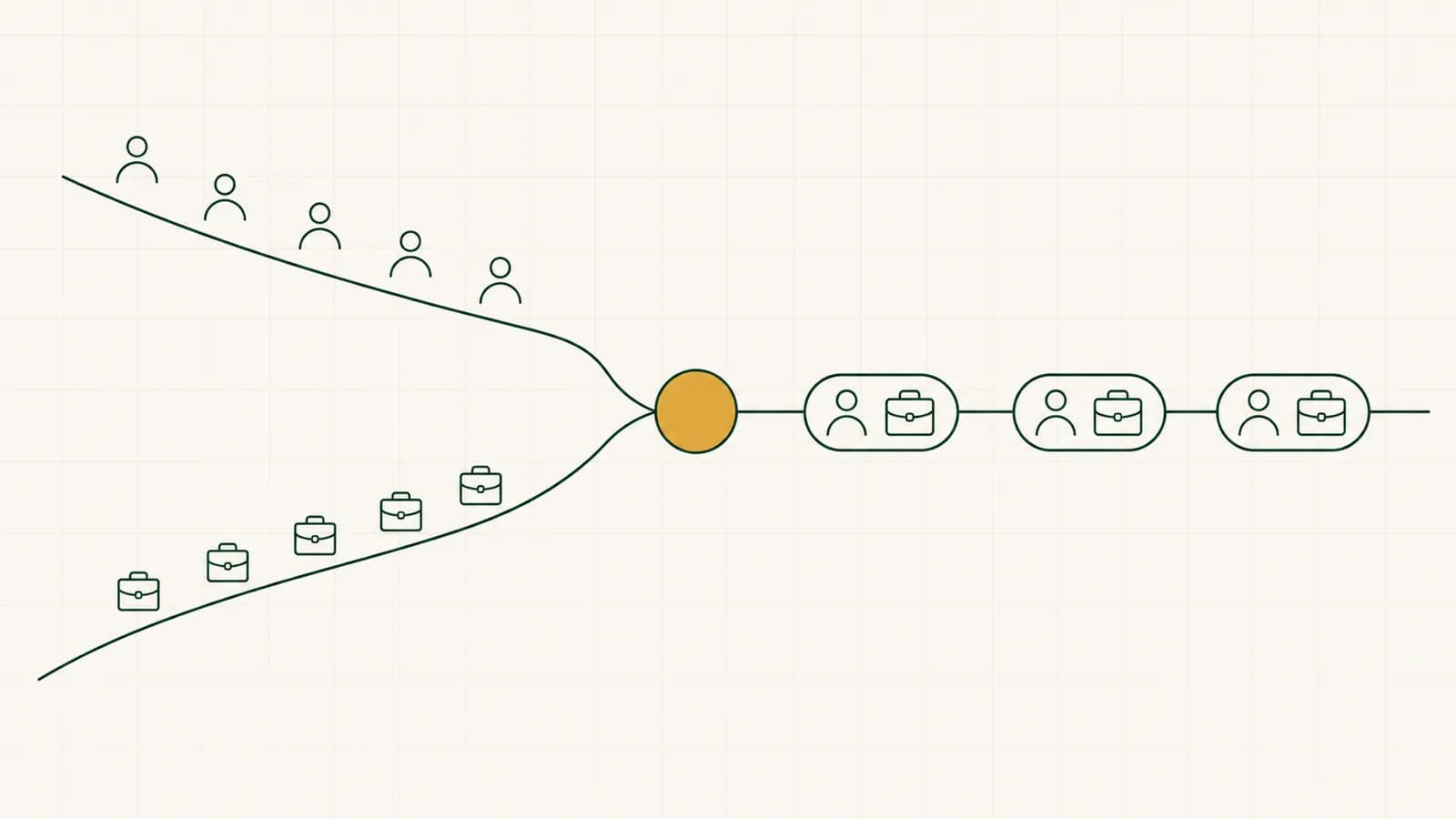
Whoever searches for a recruiting system is usually looking for a way to stop the flood: too many candidates, too many roles, and too many hours burned on manual screening. The problem is not a shortage of applications. It is volume. And in staffing and placement agencies especially, the volume is doubled: candidates looking for work on one side, employers who need workers on the other. A good recruiting system has to manage both sides, not just store resumes.
What a recruiting system actually has to solve
Most tools in the category are a repository: a place to collect candidates, tag them and search. That helps with storage, but not with the real bottleneck, which is the human moment. Someone has to answer every candidate, check whether they fit, cross-reference them against the open roles, and schedule an interview, all while employers on the other side wait for an answer. As volume grows, the team spends the day screening and scheduling instead of placing. And every good candidate who didn't get a fast reply is already talking to another agency.
The candidate track: screening and matching with an immediate reply
A managed AI sales system calibrated to the staffing world manages the candidate track end to end:
- An immediate reply to every candidate, at any hour, before they move on.
- Screening and matching: the agent verifies basic fit, reads the resume, and checks it against the open roles in real time.
- Interview scheduling straight into the recruiter's calendar, only when there is a real match.
The result: the recruiter doesn't get a raw pile of applications but a screened, matched, scheduled candidate. The time that went into "going through the inbox" returns to the work that produces revenue.
The employer track: qualifying the need and connecting it to a role
The other side of the market runs in parallel. For a business that needs workers, the agent explains what's available, asks the right qualifying questions, role, requirements, timelines, and closes the loop against the matching candidates. Both tracks run together, and that is exactly what a standalone storage tool doesn't do: it holds candidates or roles, but doesn't manage the connection between them.
Scale without hiring more staff
The big advantage of managed automation is scale. At Keshet Solutions, a staffing and placement agency, a system of agents manages up to 100 lead conversations a day across both sides of the market, a volume no human team holds manually, and freed the team dozens of work hours a month. That is not "fewer people"; it is the same team moving from screening to the placements themselves.
Where the human recruiter comes in
Good recruiting is, in the end, a human decision. So the division here is the same as in any managed system: some 10-20% of the processes complete autonomously end to end, and some 80-90% reach a person ready for action. The agent holds what has to be consistent, availability, screening, role checks, scheduling, and the recruiter steps in at the point where they truly create value: the final match, the negotiation, the placement. Recruiting is, ultimately, a two-sided sales process, and that is exactly what a managed sales system knows how to do.
Frequently asked questions
How does a recruiting system screen candidates automatically? The agent replies to every candidate immediately, verifies basic fit, reads the resume and checks it against the open roles in real time. When there's a match, it books straight into the recruiter's calendar. The recruiter gets a screened, matched candidate, not a raw pile of applications.
Can you schedule interviews and screen resumes without adding staff? Yes. The agent manages the sequence from intake to a scheduled interview, at any hour and at volume. The team stops drowning in manual screening and gets back to placements themselves, the point where it truly creates value.
How do you manage both candidates and employers in one system? In two parallel tracks: a candidate track that screens and schedules, and an employer track that qualifies the need and connects it to a role. Both sides of the market get an immediate reply, a volume that's hard to hold manually.
What's the difference between a recruiting system and a managed sales system? No fundamental difference. Recruiting is a two-sided sales process. The same mechanism that manages sales leads (immediate reply, screening, follow-up, scheduling) manages candidates and employers too. It's a managed AI sales system calibrated to the staffing world.
If your team is busy screening instead of closing.