Article
Business automation: where to start, what to leave to people
Business automation for small businesses: what to automate first, what stays with people, and why sales automation is not marketing automation.
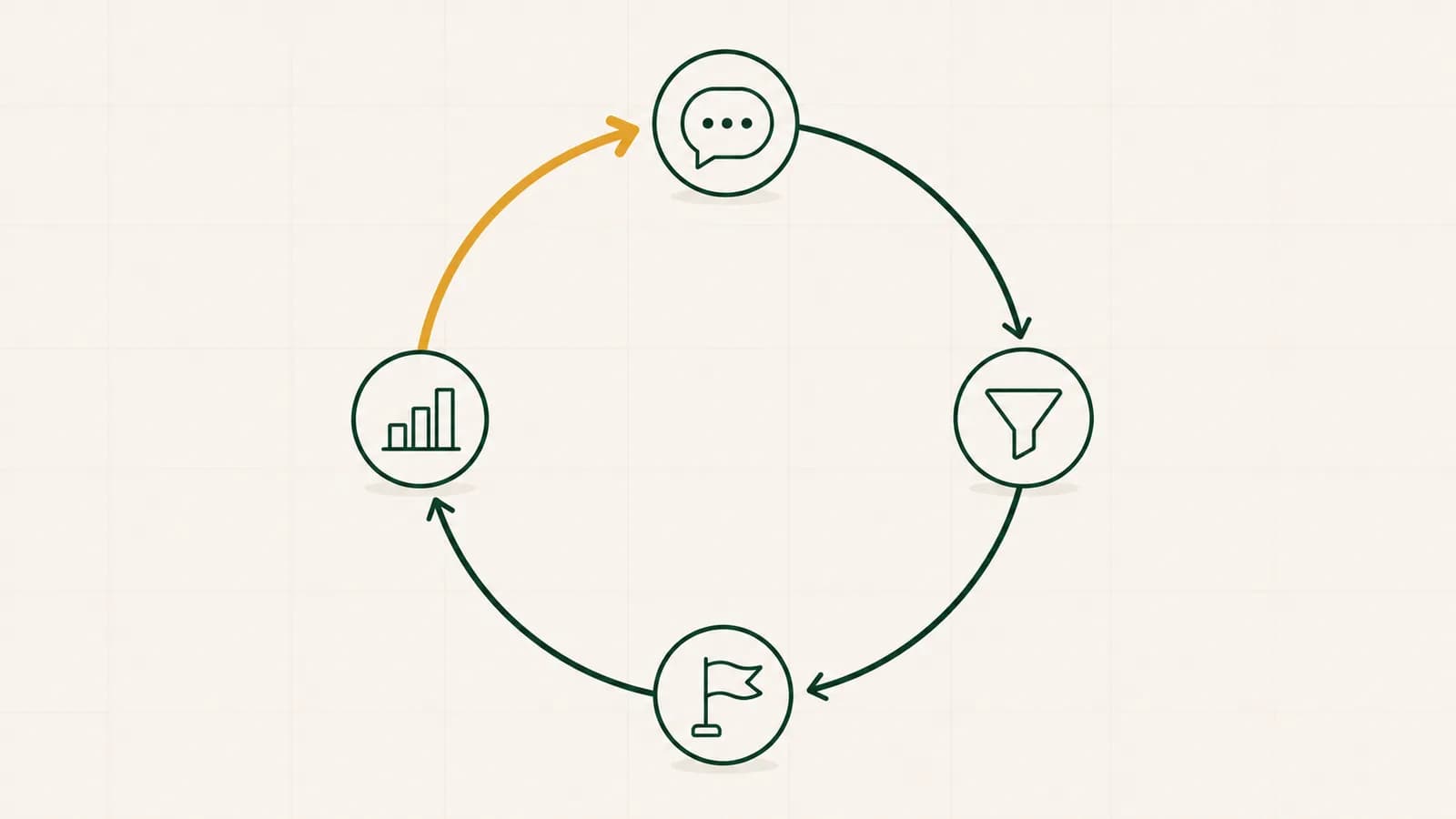
Business automation starts with what repeats every day and follows clear rules: the first reply to an inquiry, capturing the lead into the system, booking meetings and reminders, invoicing and collection. What needs judgment stays with people: negotiation, complaints, closing a high-value deal. Marketing automation brings the lead to the door; sales automation manages what happens after they walk in.
A lead wrote "how much does it cost?" at 10:40 at night. By morning, when someone opened WhatsApp, he had already bought elsewhere. That business was not short of people. It was short of order. Most businesses start with what is easy, mailings, posts, invoices, and leave manual the one thing that decides: the first reply. An invoice that goes out by itself is a success you can see. A lead nobody answered at night is a loss nobody writes down.
The rule: where to start
Six questions for every task. Whatever answers "yes" to all of them, start there:
- Repeats? Every day, on every inquiry.
- Rule-based? You can write down what is right without "it depends".
- Measurable? How many were answered, how fast.
- Reversible? A mistake is fixed with one more message.
- Low risk? A mistake doesn't cost trust or money.
- A path to a person? When something goes off track, there is someone to hand it to.
The first five automations for a small business
1. The first reply to an inquiry. The highest return, because speed is conversion. In a Harvard Business Review study from 2011, still cited because no study of that scale has been published since, a lead answered within an hour was about 7 times as likely to have a meaningful conversation as one answered an hour later (HBR, 2011). The number is old; the phenomenon isn't: since then customers have only got used to faster answers. What the study really measures is how fast the wish disappears, and the next section is about that. What our data from 100+ businesses shows is in the article on lead response time.
2. Capturing the lead without typing. A lead that records itself, with what was said in the conversation, saves the thing salespeople least like doing: updating. A lead that isn't recorded gets no follow-up, because it isn't on the list.
3. Booking, confirmation and reminder. Booking in the calendar inside the conversation, without "when suits you?". Every round of "when suits you?" is another day in which the decision can cool.
4. Invoice and collection on payment. A receipt that goes out by itself; a reminder nobody has to remember.
5. Frequently asked questions. Hours, address, basic pricing. A simple bot is enough here; when it isn't, see the article on WhatsApp bots.
Why reply speed converts
Not because fast is polite. Because a lead who writes at 10:40 at night is in the moment of intent: they searched, compared, decided to ask. In the morning their need is the same, but the momentum is gone. Their head is somewhere else, at work, in traffic, and if a competitor answered them at night, your question is no longer open. Intent decays by the hour, not by the day, which is why "we'll get back to you tomorrow" is not a delay. It is a different conversation, with a person who is no longer looking.
Here is what it looks like, in four messages:
- The lead, 22:40: "How much does it cost?"
- Without automation: Silence until nine in the morning. Their next message goes to someone else.
- With an auto-reply: "Thanks for your message, we'll get back to you during business hours." What they read: nobody is here.
- With an agent: "Depends what suits you. Is this for one treatment or a course?" They answer "a course, for my back". The agent explains what a course includes, asks when they can come in, and offers Sunday morning. They confirm. At nine in the morning the rep sees a meeting in the calendar, not a cold lead.
The third line is more dangerous than the first. Silence can be read as "busy"; an auto-reply tells the customer explicitly that nobody is going to answer. Automation that only acknowledges receipt gains no time.
What stays with people, or at least isn't where you start
What stays with a person is the close, not the coordination. Price negotiation. A complaint. The decision whether a high-value customer is right for you. And any commitment, on price, on timing, on terms; automation that promises what was not approved costs more than it saves. And the fourth one everyone forgets: consent. A proactive marketing message on WhatsApp needs explicit prior consent, and whoever lets the system send to a list without checking is letting it generate a lawsuit. The details are in the article on Israel's spam law on WhatsApp.
Sales automation vs. marketing automation
| Marketing automation | Sales automation | |
|---|---|---|
| Stage in the funnel | Before the lead comes in | After the lead comes in |
| Model | One message to a whole audience | A conversation with one person |
| What triggers it | Audience behavior: a visit, a download, an abandoned cart | One person's buying signal: an inquiry, a question, silence |
| What it does | Forms, mailings, drip sequences, retargeting | Reply, qualification, follow-up, moving toward a meeting or a close |
| The output | A lead | A meeting or a deal |
In most businesses the first exists and the second doesn't: the campaign brings inquiries, and then someone has to answer. That is no accident. Marketing automation is sold with the campaign; sales automation comes with nobody, because it starts where the marketer finished. That is where the money you spent on the campaign waits for someone to answer. How the two connect is in the article on marketing automation.
The mistakes of too much automation
They all come from a missing boundary. A mailing sequence and a sales sequence running in parallel on the same person. A bot that keeps sending after a rep has already joined. A system that invents a price or a date. Sending without consent. And a bot that can't say "I don't know", and guesses. The six questions in the first section prevent all of them.
When automation becomes a managed system
Most businesses do not need an AI agent. If your sale is "how much, fine, when can I come", a fast reply, a calendar and a reminder are enough, and that's that. The managed system is built for a different business: one whose sale runs through a conversation, with hesitation, with objections, with follow-up across days, and with a customer worth enough for someone to manage the path to them. If that isn't you, save the money. If it is, standalone automations will hit their limit fairly fast.
The limit looks like this: the reply doesn't know what happened in the follow-up, the calendar doesn't know what was said in the conversation, and the CRM waits for someone to update it. According to Salesforce's State of Sales for 2026, reps spend 60% of their time on non-selling tasks, including data entry and lead research (Salesforce, 2026). Notice what that number says about partial automation: every tool you added needs updating, and the updating lands on the same person who already can't find time to sell. More separate automations, more seams where someone carries information by hand. That is the line between a collection of automations and a managed system, one system that joins reply, qualification, follow-up, calendar and CRM into one path to close, so that documentation is a by-product of the conversation and not a task.
In such a system about 10-20% of deals close autonomously end to end, and about 80-90% reach a person ready to close. Not AI that replaces people. Autonomous as far as possible, up to the point where a person is needed. Upperfloor is a managed AI sales system on WhatsApp for businesses that already receive inquiries. What exactly that is, in the article on managed AI sales; who does what between the agent and the rep, in AI sales agents vs. reps.
According to HubSpot's State of Sales for 2025, 84% of salespeople say AI saves them time (HubSpot, 2025). A vendor survey, so take it as a reading of the mood, but the mood is clear: the argument about "whether" is over. What remains is the order, and the line past which a person is needed. And if you do only one thing this week: check when the last inquiry that came in after eight in the evening was answered.
FAQ
Where should a small business start with automation? With what repeats every day and follows rules: the first reply to an inquiry, capturing the lead into the system, booking meetings and reminders, invoicing and collection, and frequently asked questions. These are repetitive, measurable and reversible, so they are safe to automate.
What stays with people in sales? Price negotiation, handling a complaint, closing a high-value deal, and any commitment to a customer. These need judgment and trust, and automating them hurts conversion instead of raising it.
What is the difference between sales automation and marketing automation? Marketing automation speaks to a whole audience and brings in leads: forms, mailings, drip sequences. Sales automation runs a conversation with one person after the lead comes in: reply, qualification, follow-up and moving toward a meeting or a close.
Does automation hurt service in a small business? Automation hurts service when it keeps sending after a person has joined the conversation, promises what was not approved, or sends without consent. Automation that knows when to stop and hand over to a person improves service, because every inquiry gets answered.
How do you start automating without a technical team? Start by mapping one working week: which tasks repeat, how long they take, and where inquiries fall through. Pick one process, usually the first reply to an inquiry, let the system handle it, measure, and only then move to the next one.
If you're trying to work out where to start with automation in your business.