Article
WhatsApp Business Policy and AI Agents: What's Allowed Now
What Meta allows AI agents on WhatsApp Business: opt-in, 24-hour window, templates, a path to a human. Why a managed sales agent stays within the rules.
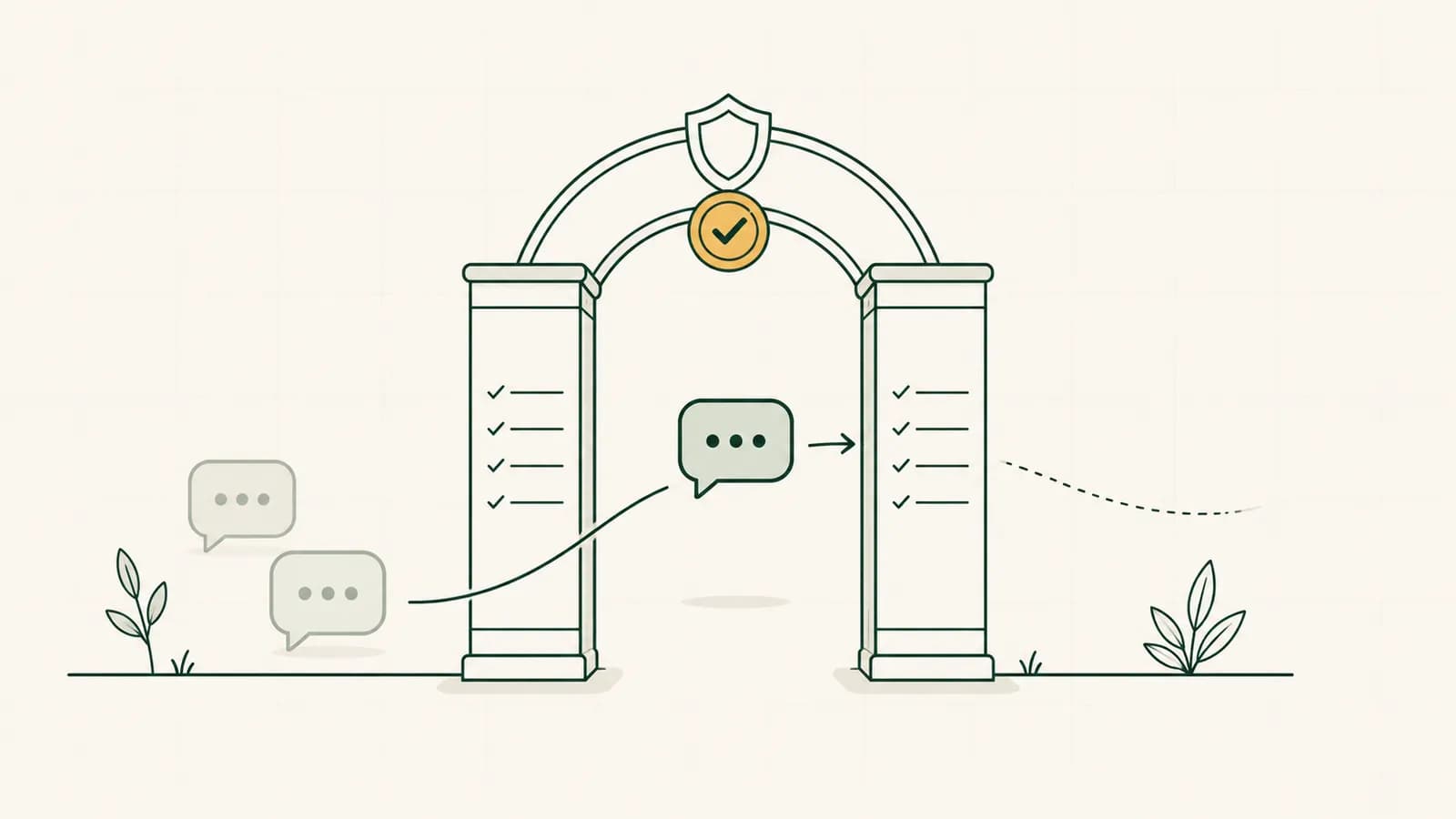
Meta allows businesses to run their own AI agents on WhatsApp, under clear conditions: prior consent (opt-in), the 24-hour service window, approved templates for proactive messages, and an available escalation path to a human. What was restricted in 2026 is general-purpose AI assistants whose product is the AI itself, not an agent a business runs for its own customers. And from October 1, 2026, pricing changed too: service messages are no longer free.
WhatsApp is the main sales channel for many businesses in Israel, so Meta's rules are not a "technical detail." They are the infrastructure that determines what a conversational agent may do with a customer. Over the past year Meta changed several of these rules in meaningful ways, and some of the changes bred confusion. This article separates what actually happened from what circulates online, and shows why a business running a dedicated sales agent sits on the comfortable side of the line.
One thing up front: this is an educational overview of the policy landscape as of October 4, 2026, not legal or regulatory advice. Parts of the policy keep evolving, and parts are currently contested before regulators.
What Meta banned in 2026, and what it did not
The headlines in late 2025 created the impression that Meta was "banning bots on WhatsApp." That is a misreading of what happened, and the distinction here is the whole story.
In October 2025 Meta published new terms for the WhatsApp Business Platform. Under them, providers and developers of AI technologies, including large language models and general-purpose AI assistants, may not use the platform when that technology is the primary functionality, rather than incidental or ancillary. Businesses that signed up from October 15, 2025 were bound from the day they joined, and existing users from January 15, 2026. The clause now sits in section 4.7 of Meta's terms for the WhatsApp Business Platform (last modified September 23, 2026).
What Meta did not ban is an AI agent a business runs for its own customers, for service, appointment scheduling, order tracking, lead qualification or sales. The ban applies when the AI is the product; when it is a tool that helps a business serve its customers, it is ancillary. The European Commission put it the same way when it opened its investigation: businesses may still use AI tools for ancillary or support functions, such as automated customer support offered via WhatsApp (European Commission, December 4, 2025). In other words: what was restricted is the generic assistant; what remains legitimate is the business's own dedicated agent. A managed sales agent, calibrated to a specific business's product, market and process, sits on the allowed side of that line.
For precision, and because we are careful not to present an open dispute as a settled fact: the restriction on general-purpose AI assistants is contested and in motion. Brazil's competition authority suspended the new terms in January 2026 (CADE, January 12, 2026, in Portuguese). The European Commission opened an antitrust investigation in December 2025, and in June 2026, as an interim measure, ordered Meta to "restore free access to WhatsApp for rival general-purpose AI assistants" in the European Economic Area until the investigation ends (European Commission, June 9, 2026). Meta's current terms already allow such assistants in certain countries. So for general-purpose assistants, the status varies by region. For the business's own agent, which is what matters here, the foundation is stable: allowed.
The rules that apply to an AI sales agent on WhatsApp
Beyond "allowed or banned," there is a day-to-day framework every conversational agent on WhatsApp Business operates within. These are documented in the developer docs and the WhatsApp Business messaging policy:
- Prior consent (opt-in). You may contact a customer only if they gave you their number and agreed to receive messages from you (WhatsApp Business Messaging Policy). In Israel this is a double requirement, from both Meta and the law (see our article on AI agent regulation).
- The 24-hour service window. When the customer writes first, a 24-hour window opens in which the business replies with free-form messages; every new inbound message resets it. Outside the window, approved templates only (Meta developer docs).
- Message categories. Meta sorts proactive messages into template categories: Marketing (promotions, re-engagement), Utility (expected updates following a customer action: an order, an appointment, a payment), and Authentication (one-time codes). A free-form reply inside the service window is not a template.
- Quality rating. Every number carries a quality rating, green, yellow or red, derived from how recipients responded to your messages over the last seven days (Meta).
- Tiered volume limits. The number of different customers you can message first in 24 hours rises in tiers: 250, 2,000, 10,000, 100,000 and unlimited. Since October 7, 2025, the limit is calculated at the business portfolio level and shared by all its numbers (messaging limits).
- An enforcement ladder. Violations run from a warning through temporary blocks on sending messages and account locks to permanent shutdown (policy enforcement).
The common denominator across all these rules is clear: Meta rewards behavior the customer welcomes, consent, relevance, timely replies, and punishes flooding. That is the exact opposite of "a cheap bot blasting messages," and it lines up with how a managed sales system is supposed to work anyway.
Automation is allowed, provided there is a path to a human
This is the most important point for a business, and also the one the policy itself states most precisely.
The WhatsApp Business Messaging Policy (last updated September 23, 2026) explicitly permits automation when responding inside the 24-hour window, but requires prompt, clear and direct escalation paths: an in-chat transfer to a human agent, phone, email, web support, an in-store visit, or a support form. In Meta's terms, automation is not a substitute for a human; it is a layer that must be backed by the ability to reach one.
That is exactly the model of a managed AI sales system, and not by coincidence: the AI holds the sequence, availability, immediate replies, follow-up, qualification, and a human steps in at the points where they truly create value. In practice, some 10-20% of deals close autonomously end to end, and some 80-90% are handed to a rep ready to close. The escalation path to a human is not just "nice to have"; at Meta it is part of the policy. A system built right includes it by default.
What changed in pricing and structure, and why it is consistent with managing well
Over the past two years Meta changed the platform's pricing model several times. According to the official pricing page (updated September 30, 2026):
- From November 1, 2024, service conversations, the replies to a customer who wrote first, were free for all businesses.
- From July 1, 2025, Meta charges per message rather than per conversation: every template message delivered is charged by its category and the recipient's country.
- From October 1, 2026, Meta charges again for service messages, beyond 1,000 free service messages a month per business phone number, and for utility messages sent in response to customers inside an open service window, which had been free since July 2025.
We will not quote rates here; they vary by country and category. What each category covers, and the current rates for North America and the UAE, are in our article on the WhatsApp Business API. What matters here is the direction: replying itself now costs money, so a business that manages a conversation toward an outcome, instead of exchanging messages that move nothing forward, is on the right side of both the policy and the economics.
Direct connection vs. an intermediary, and why it matters
Not everyone running WhatsApp Business is connected to the platform the same way. Meta's documentation describes two main partner types: a Solution Partner, which provides the business with the service and also bills it for messages, and a Tech Provider, which connects businesses to the platform without a credit line of its own. With a Tech Provider, the business adds its own payment method, Meta bills it directly for usage, and the provider charges only for its own services (Meta, solution providers).
Upperfloor is a Meta Tech Provider, and its platform connects only through the official API. What that means for a business, and how the connection works in practice, is in our article on the WhatsApp Business API. In the background, another Meta move: the old On-Premises API reached end of life on October 23, 2025, and the whole platform moved to the Cloud API hosted by Meta (Meta).
Disclosure, transparency, and trust
A recurring question: must you tell the customer they are talking to AI?
The answer is more precise than commonly assumed. WhatsApp's messaging policy and the platform terms contain no explicit requirement to disclose that AI is involved. What they require is an available escalation path, not to "confuse, deceive, defraud, mislead, spam, or surprise people", and compliance with applicable law. Where a duty to disclose an AI system exists, it comes from external regulation, for example Article 50 of the EU AI Act, which applies from August 2, 2026, not from Meta's rules. We cover this in a separate article on AI agent regulation.
Beyond the legal question, there is a stance here. Upperfloor does not claim the AI cannot be recognized, and does not sell an "undetectable bot." What we do build: an agent that manages a natural, human conversation, with a clear path to a person when needed. That aligns with the spirit of Meta's rules, and with building trust over time.
Meta is building an agent of its own, and how it differs
One more step worth knowing: in June 2026 Meta introduced a built-in AI agent for businesses on WhatsApp and Messenger that answers questions, recommends products from a catalog, books appointments, qualifies leads and lets the business decide when a team member steps in. According to Meta, more than a million businesses already use it (Meta, June 3, 2026).
It confirms the direction: AI agents for businesses are the future Meta itself is building toward. It also sharpens the distinction between two legitimate approaches. One is a built-in tool the business configures, maintains and operates itself. The other is a managed system: an agent that is built, deeply calibrated to the business's market and process, and managed end to end, as part of a system that holds the whole path to close (conversations, follow-ups, calendar, CRM, data). The difference is between infrastructure you assemble yourself and a system that manages it for you.
What this means for your business
If WhatsApp is your sales channel, three practical conclusions:
- A dedicated AI agent for your business is allowed. What was restricted is general-purpose AI assistants, not the agent that manages your sales.
- The rules reward managing well. Opt-in, timely replies, relevance and a path to a human are both Meta's requirements and what a managed system does anyway.
- Replying costs money now, too. Since October 1, 2026, service messages are charged beyond the free monthly tier, so a conversation that moves forward is worth more than one that only answers.
Upperfloor is built to operate inside this framework, not as a generic wrapper, but as a managed sales system, with a human in the loop. The path to close. Managed.
Frequently asked questions
Does Meta ban bots or AI agents on WhatsApp? Not across the board. Since January 15, 2026 (and from October 15, 2025 for businesses that signed up from that date), Meta's terms bar AI providers from using the business platform when the AI is the primary functionality, such as a general-purpose AI assistant. A business that runs an AI agent to serve its own customers is not covered by the ban. The ban itself is before regulators in Europe and Brazil, and Meta's current terms allow exceptions in certain countries.
Do you need the customer's permission to message them on WhatsApp Business? Yes. Meta's policy requires opt-in: the customer gave their number and agreed to receive messages. In Israel the requirement is double: both Meta's policy and the anti-spam law require prior consent before a commercial approach. A proactive message outside the service window requires an approved template.
What is the 24-hour window on WhatsApp Business? When a customer messages the business first, a 24-hour service window opens in which the business can reply with free-form messages, and every new inbound message resets it to 24 hours. Outside the window, only approved templates can be sent. Since October 1, 2026, Meta also charges for service messages inside the window, beyond 1,000 free messages a month per business phone number.
Is a business required to disclose that the customer is talking to AI? WhatsApp's messaging policy and the platform terms have no explicit AI-disclosure requirement. They require an available escalation path, no misleading, and compliance with applicable law. A duty to disclose that an AI system is involved comes from external regulation, such as Article 50 of the EU AI Act, which applies from August 2, 2026. Either way, transparency is the foundation of trust.