Article
WhatsApp chatbot: an AI agent that answers and books
AI chatbot for business, answering service or AI agent? What a WhatsApp chatbot solves and what it doesn't, the three options side by side, and how to choose.
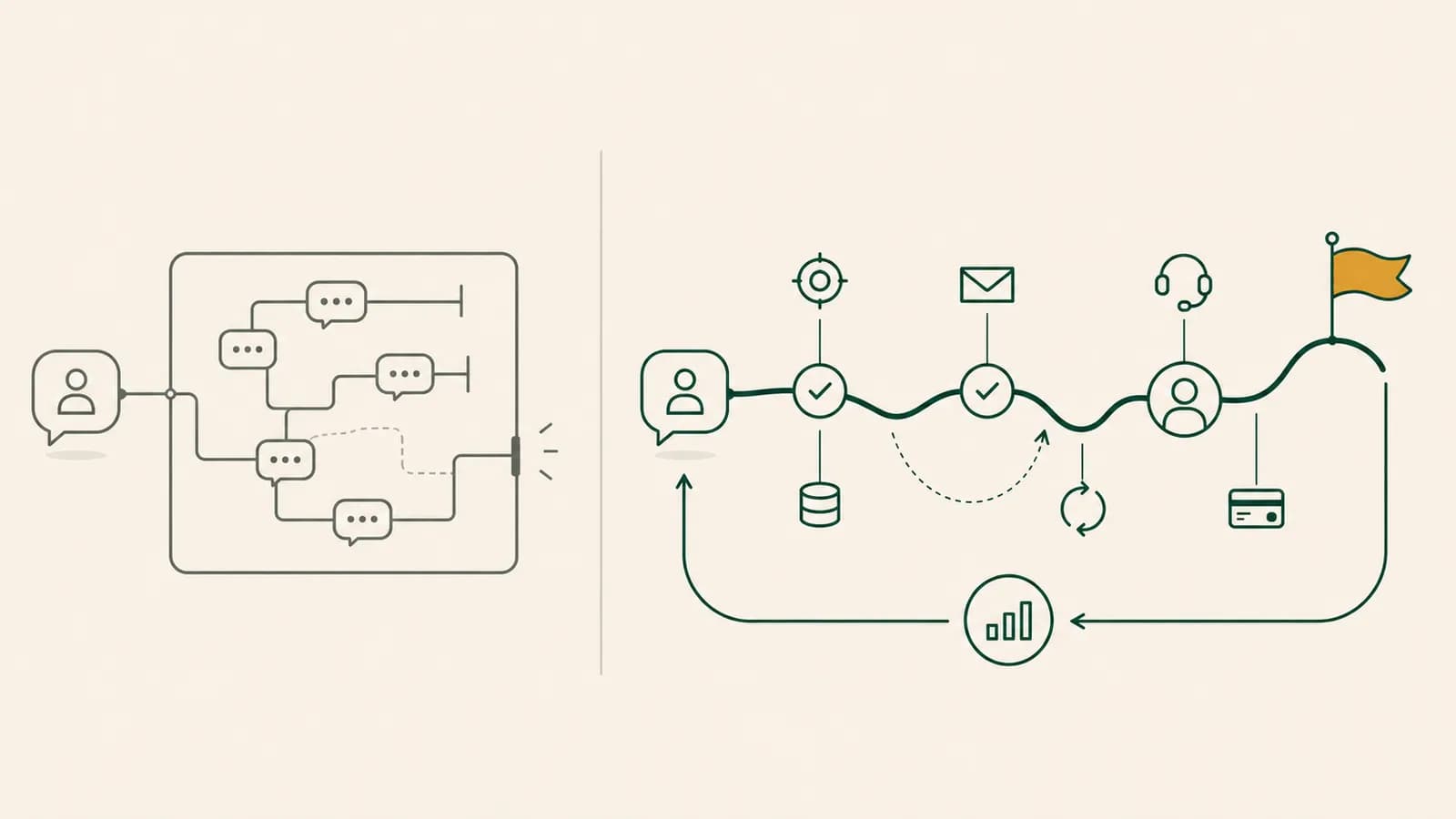
An AI chatbot for business answers customer messages automatically, from a script or a menu: business hours, basic pricing, order status, routing. It solves the questions that have one right answer, at any hour. It does not solve a sales conversation: hesitation, objections, comparisons, follow-up over days. That takes an AI agent that manages the conversation, books the meeting, and sometimes closes the sale itself.
A patient called a clinic to ask who "the lovely lady" was who had been chatting with her on WhatsApp. It happened at Yin Tang, a Chinese medicine clinic in Israel, and nobody had promised it. But that is exactly where the line runs between the three ways businesses try not to miss an inquiry: a chatbot, an answering service, and an AI agent. The difference is not in the feature list. It is in what happens at the second message, when the customer is no longer asking what time you open.
Three ways not to miss an inquiry
| Bot | Human answering service | AI agent | |
|---|---|---|---|
| Where it answers | Website chat or WhatsApp | Phone | WhatsApp, Instagram, TikTok and Messenger |
| A question outside the script | Gets stuck | The operator answers within the brief they were given | Understands and answers from the business's own knowledge |
| Follow-up | A fixed message sequence | Usually none | Follow-up that responds to what the customer said |
| What reaches your team | Details in a list | A message to call the customer back | A qualified lead with the full conversation, or a closed deal |
| Who improves it over time | You | You, by briefing them | Managed, and every conversation is reviewed |
A comparison of solution types as they typically are, not of any specific vendor.
The row that decides it is the second one. A bot and an answering service are exactly as good as what someone prepared for them in advance: the bot's script, the operator's brief. An AI agent answers from what it knows about the business, so the question nobody anticipated is, for the agent, the start of a conversation rather than the end of one.
Answering service, virtual receptionist, chatbot or agent: when each fits
A human answering service or a virtual receptionist fits when most of your inquiries come in by phone, and you mainly need someone to pick up and pass on a message. You get a human voice and a list of people to call back, and from there the work is yours again.
A chatbot fits when the questions repeat and are simple, hours, location, order status, and there is no sales conversation. If that is most of what comes in, a simple bot will save you time, and there is no reason to pay for more.
An AI agent fits when you already receive inquiries in writing, and the sale needs a conversation: questions, objections, follow-up. That is where the difference between something that answers and something that manages the conversation is the difference between an inquiry and a meeting.
Behind any WhatsApp chatbot sits the same machinery, a trigger, a script and a 24-hour clock that decides what it may send and when. How that works, and what it takes to build one, is in our guide on how to create a WhatsApp bot.
Where an AI chatbot for business hits its ceiling
Bots don't fail. They answer what was anticipated, which is what they were built to do. A rule-based bot recognizes a pattern in a message and returns the answer tied to it, so it is good right up to the edge of the script: past the phrasing someone predicted, it has nothing to hold on to. And past that edge, customers rarely give a second chance. In a Gartner customer survey published in September 2026, only 27% said they would be willing to try a chatbot again after a negative experience (Gartner, 2026).
In sales, the conversation always goes past the edge. The customer mixes a price objection with a spec question, jumps back, mentions another offer. That is where a script-based bot hits its ceiling, and where the cost shows up: in Zendesk's CX Trends 2026 report, 85% of CX leaders say customers will drop brands over unresolved issues, even on the first contact (Zendesk, CX Trends 2026). "Even on the first contact" is the phrase that matters. The customer the bot got stuck with doesn't try again tomorrow with a person. They write to someone else, and as far as they're concerned, the problem is solved.
For simple questions, a bot is perfectly fine. "What are your hours?" isn't a sale. Selling a high-value deal takes exactly what lies past the ceiling: nuance, trust, and an objection nobody wrote into the script.
Why customers stop talking to a bot
A sales conversation is an exchange: the customer gives you information about themselves, what they need, what bothers them, what they're comparing you with, in return for attention. They keep giving as long as they feel someone is listening, and they stop the moment a reply proves nobody read it. A generic answer is that proof. "Choose from the menu" after "I found it cheaper" tells the customer that what they shared reached no one, and from then on they stop sharing. They're not angry; they just start saving their words for a place where words count.
That is why a bot's ceiling isn't a "more scripts" problem. Every new script covers one more phrasing, but the customer isn't testing your phrasing. They're checking whether their question moved. An agent that manages the conversation holds on to what the customer said and responds to it, so the exchange continues: more information, more context, closer to a close. From the customer's side, the difference between a bot and an agent is the difference between talking to a wall and talking to someone. What actually makes software an agent, and not a bot with a new name, is in our plain definition of an AI agent.
How it sounds to the customer
The customer doesn't know whether a rule-based bot or a language model sits behind the message. They know how it feels. A bot sounds like a bot: generic replies, "choose from the menu", a mechanical tone. An agent that manages the conversation sounds different: it flows and answers the point.
The proof comes from customers, not surveys. Shoval, CEO of Motorace Israel, wrote in a public Google review that "few (!!!) customers realize the conversation is run by an AI agent". At IMBODY, a customer stopped in the middle of a conversation about an expensive fitness machine and asked: "Wait, am I talking to AI?". Notice who is saying it: the customers. We don't sell disguise, and there is always a path to a person. We build conversations that feel human, and what the customer concludes is theirs.
Not either-or: what stays with your team
"AI beats people" isn't what happens in the field. The system is built on a division of labor: the agent holds what has to stay consistent, availability, instant replies, follow-up, need discovery and booking, and your team steps in where it matters. When the product is clear and the price is transparent, the agent closes on its own, end to end; when the purchase needs trust that the conversation alone doesn't build, it brings the customer to your closer ready, with all the context. A smooth handover is the design, not the failure. Where exactly that line runs is in our article on AI sales agents and reps.
What Upperfloor's solution includes
Upperfloor isn't a better bot; it's a managed AI sales system, and what it includes is everything behind the conversation, not just the conversation. On the Upperfloor platform:
- Every conversation from every channel in one place: WhatsApp at the core, alongside Instagram, Messenger and TikTok.
- An agent that manages the conversation by context, calibrated in depth to the business's market, product and sales process, with its own name and persona.
- Follow-ups that happen on their own, on time, picking up from what the customer said last.
- A calendar that moves meetings forward, with booking right inside the conversation.
- A CRM that holds leads, customers, tasks and deals, and a team dashboard that shows where every deal stands.
- Improvement from every conversation: each agent sharpens from its own conversations, built on data from more than 100 businesses.
And if you have a CRM you don't want to leave, the system can sit on top of it as the layer that manages conversations and channels. From the field: in our own campaign in August and September 2026, the agent managed 95 leads and brought 9 of them to a paid meeting, without a rep touching the conversation before the meeting.
Three businesses, three conversations a bot couldn't hold
These are businesses in Israel, where WhatsApp is the main way customers write to a business.
Motorace, driving-experience tourism. The product draws a flood of inquiries, most of them out of range on price. Before Upperfloor, Motorace had tried an earlier automated tool, and as the information grew it demanded more and more of the team's energy. Today one agent runs the sales path from the first message to checkout, and dozens of premium deals a month close end to end.
IMBODY, a smart home fitness machine. A deal that doesn't close with "add to cart" but in a conversation: discovery, matching a model, spec questions and a price objection. At IMBODY, the agent runs the sales conversation on WhatsApp end to end, including the close.
Yin Tang, a Chinese medicine clinic. Inquiries in the evening, on weekends and between treatments, exactly when the therapist can't stop. The agent qualifies the need, closes and collects payment, and only then books the appointment, so a booked slot is a paid slot.
What to check before you buy a sales bot
Five outcome questions, not technology questions:
- How does it sound? Read a real conversation the system handled. Does it flow, or is it "choose from the menu"?
- What happens off-script? Give it an unexpected objection and a question about another offer. Does it manage, or get stuck?
- Does it improve? Calibrated to your market and your process, or frozen the day you bought it?
- Does it hold the sequence to the close? Does it only answer, or also follow up and remember?
- Is there a path to a person? Does it hand over a ready-to-close lead, or just stop?
The choice isn't "a cheap bot" versus "an expensive bot". It's between a system that answers and a system that manages the path to close. And before you sign up for a "smart bot", send it one message: "I found it cheaper." What it answers is everything you need to know.
FAQ
What does an AI chatbot for business actually do? An AI chatbot for business answers customer messages automatically, on your website or on WhatsApp, from a script, a menu or the information it was given: hours, basic pricing, order status, routing. It handles questions with one right answer at any hour. It is not built to run a sales conversation with hesitation, objections and follow-up.
When is a chatbot for business enough? A chatbot for business is enough when most inquiries are repeat questions with a fixed answer, like hours, location or order status, and there is no sales conversation. Once the sale needs a conversation, with questions, objections and follow-up, you need an agent that manages it to a meeting, a close or a handover.
Answering service, virtual receptionist or AI agent? An answering service or a virtual receptionist fits when most inquiries arrive by phone and you mainly need someone to pick up and pass on a message. An AI agent fits when inquiries already arrive in writing, on WhatsApp, Instagram or Messenger, and the sale needs a conversation: it answers from the business's own knowledge, follows up, books meetings, and hands your team a qualified lead with the full conversation.
Do customers know they're talking to a bot? Customers spot a bot when it sounds robotic; a natural, flowing conversation lowers that barrier. Some of our customers have told us themselves that they found it hard to tell the conversation was run by an AI agent, but that's their statement, not our promise.
How much does an AI agent for WhatsApp cost? There is no single price list, because it depends on your inquiry volume, your channels and your sales process. The fit, and what the system would include for you, is checked in a diagnostic meeting. Separately, Meta charges for messages on the official platform at its own rates.
If you're trying to decide between a bot, an answering service and a system that manages your sales.