Article
WhatsApp sales: Israel's hottest channel as a managed system
Managed WhatsApp sales: an immediate reply to every inquiry, the conversation managed until it's ready to close, and the full system behind the chat.
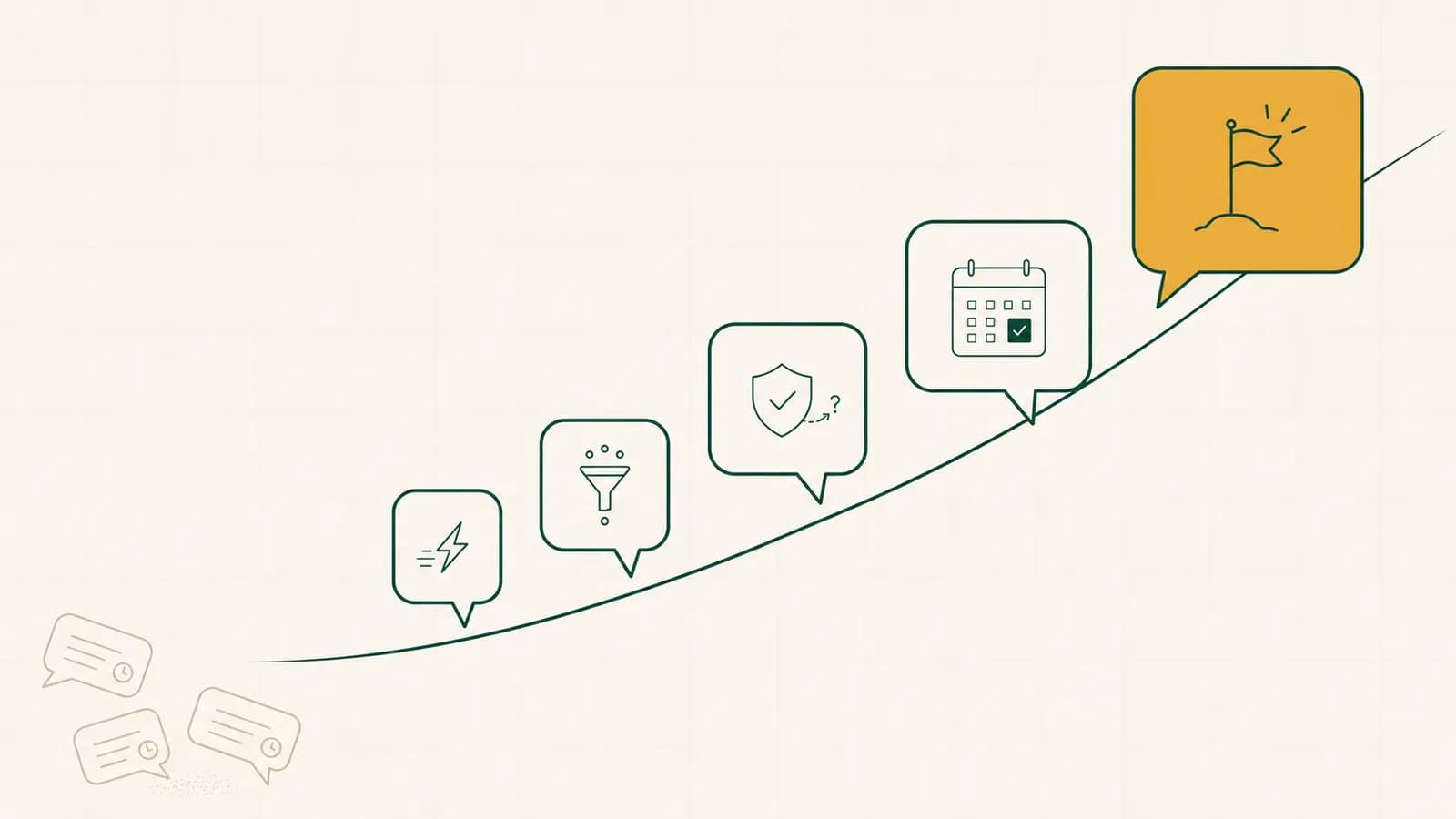
Managed WhatsApp sales mean an immediate reply to every inquiry, the conversation managed until the lead is ready to close, and the full system, other channels included, behind that chat. WhatsApp is where most customers in Israel already are, but most businesses run it by hand, and that is where leads leak. Everyone knows the channel; the management is new.
Upperfloor is a managed AI sales system on WhatsApp for businesses that already receive inquiries.
In Israel, when a business wants to talk to a customer, it messages them on WhatsApp. Not email, not an outbound call, not a form. WhatsApp. That holds for a tourism company, a clinic, a real-estate agent and an online store. The channel became the country's main sales arena, yet most of it is still run by hand, like a decade ago. This article is about that gap: why WhatsApp is where the sales happen, why that is exactly where they leak, and what the channel looks like when it is properly managed.
Why WhatsApp is Israel's sales arena
Few countries have one channel dominating business communication the way WhatsApp dominates in Israel. This is not advertising, it is daily reality: people reach a tradesperson, a clinic, a restaurant or a company through WhatsApp instead of picking up the phone.
Precise public figures on WhatsApp penetration across the Israeli population are hard to find, and that point matters, we will come back to it. The closest official figure comes from a February 2023 survey by the National Bureau for the Protection of Children Online (Unit 105) at the Ministry of National Security, which examined usage patterns among teenagers (ages 13-17): 84% of Jewish teens and 58% of Arab teens use WhatsApp. It is a survey of adolescents, not business owners, so no business "penetration rate" can be derived from it. But as an indication of how deeply the platform is rooted in Israel, it is clear.
And here the absence itself is telling: Israel has no public response audit and no business penetration metric with transparent methodology. Plenty of vendors quote impressive numbers, "90% penetration," "98% open rates," but these are recycled marketing figures with no primary source, and we will not use them. What can be said responsibly: WhatsApp is, in effect, Israel's unofficial business platform. The demand is already there. The only question is whether the business manages it, or merely survives it.
Why WhatsApp sales leak, when managed by hand
The problem starts exactly where the demand lives. WhatsApp is easy to start with, a number, a business profile, done, so most businesses run their sales on it by hand. And that works, until it doesn't.
Here is how it breaks. Swamped: when dozens of conversations arrive a day, a rep cannot answer all of them at once. Some wait, and some of the waiting go cold. Missed: an inquiry that lands at 10 PM or on Saturday meets silence until the next working day, and meanwhile the customer, who was hot, reached someone else. No follow-through: a customer who asked to "think about it" rests entirely on a rep's memory to circle back. If the rep forgot, and reps usually forget, the lead simply vanishes. No single picture: ten open conversations with ten customers, and nobody really knows who is serious, who is waiting to hear back, and where each deal stands.
This is exactly the enemy familiar from every other channel, unmanaged sales, only sharper on WhatsApp, because the expectation there is chat pace, not "we'll get back to you shortly." A customer who wrote on WhatsApp expects an answer now. And when the sales are run by hand, "now" depends on whether someone happens to be free. There is plenty of activity on WhatsApp; there is no system managing the path.
What managed WhatsApp sales look like
Now the reverse: what the channel looks like when it is managed. Not "a bot that answers," but a system that manages the path to close, with WhatsApp as the place where it happens.
- An immediate reply to every inquiry, at any hour. Not "we'll get back to you," a real sales conversation starts the moment the customer writes, at 11 PM and on the weekend too, while interest is at its peak.
- The conversation managed by context. The agent discovers the need, answers questions, handles objections and moves the customer forward, not a single reply, but a conversation that leads somewhere.
- Follow-ups that happen on their own. Whoever asked to think it over gets a follow-up at the right time, without anyone having to remember.
- A closed loop, typically about 4 hours. From the first inquiry to a lead that completed full discovery and is ready to close, or a deal that closed. And where the product allows, payment inside the conversation.
This is not hypothetical. At IMBODY, a deal for an expensive fitness machine closes on WhatsApp from inquiry to payment, the agent discovers the need, matches a model, handles the price objection and closes. At Yin Tang, the agent clarifies the need, collects payment in the conversation, and only then books the appointment. In both cases the channel is WhatsApp, and the outcome is a sale managed end to end, not just answered.
WhatsApp is the "where," the system is the "what"
Here is a point that is easy to miss, and it is the heart of the matter. WhatsApp is the channel, the place where the customer meets the business. But what manages the sale is not "WhatsApp," it is the system standing behind it.
First, customers are not only on WhatsApp. They also message on Instagram, Messenger and TikTok, and expect the same level of response. A managed sales system brings all the channels into one stream: the same customer, the same context, even if they started on Instagram and continued on WhatsApp. WhatsApp-first, not WhatsApp-only.
Second, behind the WhatsApp conversation stands a whole system: a CRM holding the leads, customers and deals; a calendar scheduling meetings; a dashboard showing where every deal stands; and data showing what is improving. The WhatsApp chat is the visible tip; the management happens in the entire layer beneath it.
That is the difference between "we have business WhatsApp" and "our WhatsApp sales are managed." The first is a channel. The second is a system that happens to answer on WhatsApp too, and manages the whole path to close, on every channel.
(One more thing worth knowing: a managed WhatsApp sale runs by the rules, customer consent to receive messages, an opt-out path, and sender identity. We cover Meta's policy and Israeli regulation in dedicated articles.)
A WhatsApp bot vs. a managed system on WhatsApp
Many businesses considering "automating their WhatsApp" think of a WhatsApp bot, a tool that auto-answers common questions. Useful, but not the same category.
A WhatsApp bot reacts: a question comes in, an answer goes out, by script. A managed system manages: it discovers the need, handles the objection, follows up and holds the sequence across days, to a close or a handoff to a rep. The difference is felt exactly where deals get closed: when the conversation leaves the script, when there is an objection, when it takes memory of what was said yesterday. (We go deeper on this distinction in the article on sales bots vs. a managed sales system.)
In short: a WhatsApp bot answers on WhatsApp. A managed system sells on WhatsApp.
How to start with managed WhatsApp sales
The first step is diagnostic, not technical. Ask yourself: when was the last inquiry that reached your business WhatsApp after working hours answered? How many of your currently open conversations can you confidently place at a stage? How many leads wrote "I'll get back to you," and you never got back to them?
The answers show the leaks. And from there, the move is not "adding a bot," but bringing in a system that holds the sequence where human memory holds it today. WhatsApp is already your channel; what is missing is who manages it. Businesses like IMBODY and Yin Tang have already made that move, the channel stayed the same channel, but it stopped leaking.
Frequently asked questions
How do you sell on business WhatsApp without missing inquiries? You stop managing it by hand. Instead of a rep jumping between conversations, a managed sales system answers every inquiry immediately at any hour, runs the conversation by context, follows up, and hands the rep a ready-to-close lead. WhatsApp is the channel; the system behind it is what never misses.
What is the difference between a WhatsApp chatbot and managed WhatsApp sales? A WhatsApp chatbot answers questions by script. A managed system manages the whole path to close: it discovers the need, handles objections, runs timed follow-ups, and holds context across days, to a ready-to-close lead or a close, including payment in the conversation where it fits.
How do you answer WhatsApp inquiries around the clock without a call center? When the reply does not depend on a human being available, every inquiry gets an immediate answer, at 11 PM and on Saturday too. A managed sales system answers at any hour, and the biggest leak disappears: leads that arrive outside working hours and get answered only the next day, after they already reached a competitor.
Are WhatsApp sales limited to that one channel? No. WhatsApp is the core, where most sales inquiries in Israel happen, but the system manages every channel: Instagram, Messenger and TikTok, alongside WhatsApp. The same conversation, the same context, and the same system managing the path to close, wherever the customer reaches out from.
If most of your sales run through WhatsApp, but you feel like you are chasing the conversations instead of managing them.